
A wet basement rarely starts as a big event. More often, it begins with a damp corner, peeling paint, a musty smell after heavy rain, or that white chalky residue showing up on the wall. When homeowners start looking for answers, the term basement waterproofing membrane comes up fast. The problem is that many people hear “membrane” and assume it solves every basement water issue on its own. It does not.
A membrane is one part of a waterproofing system. In the right application, it can be the difference between a dry basement and recurring water damage. In the wrong application, or installed without fixing the actual water path, it turns into an expensive layer covering a problem that is still active behind the wall or under the floor.
What a basement waterproofing membrane actually does
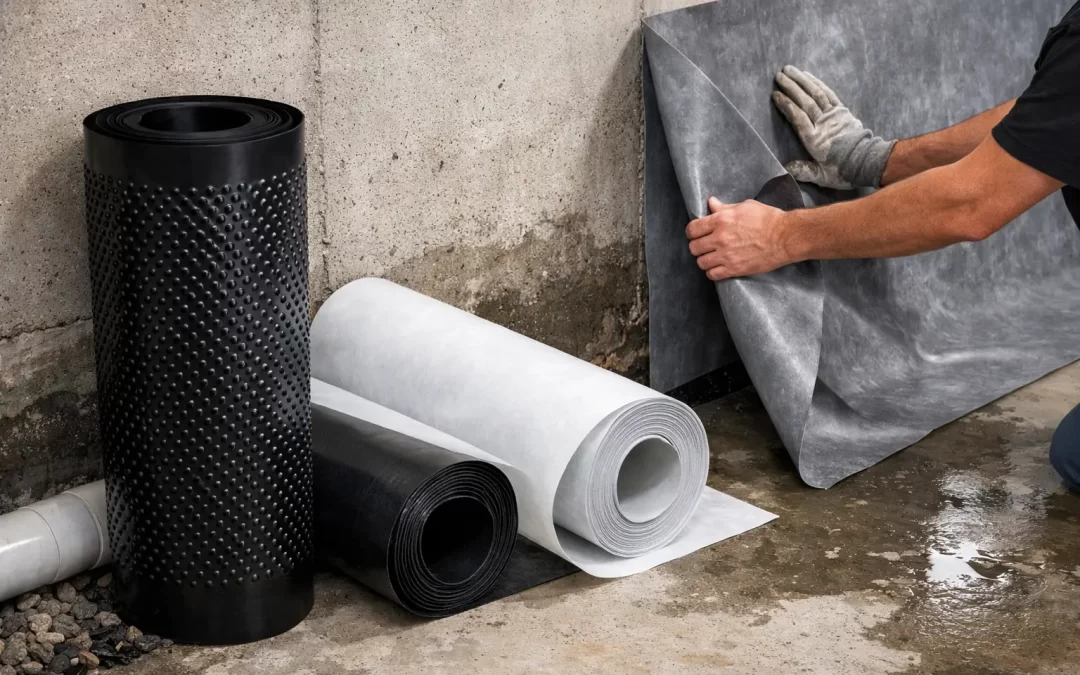
A basement waterproofing membrane is a barrier designed to stop or control water movement through foundation walls. Depending on the product, it may be sheet-based, liquid-applied, or dimpled for drainage. Some membranes are meant to block water. Others are meant to create a controlled path so water moves down to a drain tile system instead of forcing its way through concrete.
That distinction matters. Concrete is not waterproof by itself. It is porous, and once soil outside the wall becomes saturated, hydrostatic pressure pushes moisture toward any weak point it can find. That can be a shrinkage crack, a tie hole, a cold joint, honeycombing in the wall, or the cove joint where the wall meets the slab.
A membrane helps by reducing direct water contact with the foundation and managing pressure. But if the wall is cracked, the footing drain is plugged, or grade slopes back toward the house, the membrane is only addressing part of the problem.
Exterior vs. interior membrane systems
When people ask which basement waterproofing membrane is best, the real question is usually which system fits the structure, the site conditions, and the budget.
Exterior membrane systems
Exterior waterproofing is the more complete approach when outside access is possible. The wall is excavated, cleaned, repaired, and then coated or wrapped with a waterproofing membrane. In many cases, a drainage board is added over the membrane to protect it and help direct water downward to a functioning weeping tile system.
This method addresses water before it enters the wall assembly. That is a major advantage, especially where there is heavy soil saturation, recurring leakage through cracks, or visible exterior deterioration. It also gives the contractor a chance to inspect the wall condition directly and repair defects that cannot be properly handled from the inside.
The trade-off is cost and disruption. Excavation is not minor work. Landscaping, walks, decks, and nearby structures can complicate access. On some properties, exterior waterproofing is clearly the right move. On others, it may not be practical across the full wall length.
Interior membrane systems
Interior systems are different. These do not stop water from reaching the outside face of the foundation. Instead, they manage water after it comes through the wall or reaches the wall-floor joint. A common setup uses a dimple membrane on the inside wall tied into an interior drainage channel and sump system.
This can be a very effective solution when exterior excavation is limited or when the main issue is seepage at the cove joint and below-grade wall leakage. It is often less disruptive and more affordable than full exterior excavation.
Still, interior systems have limits. If the foundation wall has significant structural cracking, bowing, or active deterioration, drainage alone is not enough. You may control water at the interior, but the wall itself can keep worsening if the root structural issue is left alone.
The main types of waterproofing membranes
Not all membranes are built for the same job. Product choice should follow wall condition, water load, and installation environment.
Liquid-applied membranes
These are brushed, sprayed, or rolled onto the exterior wall surface. When properly installed over a prepared wall, they form a continuous waterproof layer with good adhesion around irregular surfaces.
They work well on many poured concrete walls, but surface prep is critical. If the substrate is dirty, wet beyond product limits, or poorly repaired, performance drops. Thickness control also matters. A membrane that is too thin at corners, joints, or patched areas becomes a weak point.
Sheet membranes
Sheet systems are manufactured barriers applied to the wall in rolls or panels. They can provide consistent thickness and strong waterproofing performance, especially when seams and penetrations are detailed correctly.
Their weakness is installation quality. Seams, overlaps, and transitions have to be clean and tight. One bad termination can create the path water needs.
Dimple or drainage membranes
These are often mistaken for waterproofing in the strict sense. Their main job is drainage and wall protection. They create an air gap or drainage space that relieves pressure and directs water downward.
They are often used with exterior coatings or on interior wall systems. In many basements, they are a smart part of the assembly, but they should not be confused with crack repair or full waterproofing by themselves.
Why membranes fail
Most membrane failures are not really product failures. They are diagnosis failures or installation failures.
If downspouts dump water beside the house, if grading traps runoff against the wall, or if clay soil holds water tight around the foundation, the wall will stay under pressure. In that case, even a good membrane is working in harder conditions than necessary. The same goes for broken weeping tile, unsealed utility penetrations, and cracks that were covered instead of properly repaired.
In our region, soil movement and freeze-thaw cycles add another layer of risk. Expanding clay and seasonal movement can stress foundation walls and open pathways that did not exist when the original waterproofing was installed. That is why a membrane should never be treated as a one-size-fits-all product. The site and the structure have to be read correctly first.
When a membrane is the right fix
A membrane makes sense when water intrusion is tied to wall exposure, exterior saturation, deteriorated dampproofing, or recurring seepage that needs a managed drainage path. It is also a strong option when excavation is already being done for crack repair, foundation repair, or drainage replacement.
It is not the whole answer when the core issue is settlement, major structural cracking, a failing sump system, or slab water pressure with no drainage relief. In those situations, the membrane may still be part of the repair plan, but not the entire plan.
That is where experienced diagnosis matters. Homeowners often want a simple answer: membrane or no membrane. Field conditions are rarely that neat. One basement may need exterior crack repair and membrane protection. Another may need an interior drainage system and sump upgrade. Another may need grading correction first because the basement leak is really a surface water problem.
What homeowners and property managers should ask before approving waterproofing work
Before any waterproofing system is installed, ask where the water is entering, what pressure conditions exist around the wall, whether cracks or joints are being repaired, and how the drainage component will work. Ask what happens to water once it reaches the membrane. Ask whether the repair is stopping entry, redirecting it, or simply hiding signs of it.
Those questions matter on residential homes and commercial properties alike. A finished basement, office space, school, or mechanical room all have different risk levels when moisture gets in. Mould, material damage, and long-term concrete deterioration can push a manageable leak into a much bigger problem.
A good contractor should be able to explain the repair in plain language. If the answer is just “we put membrane on it and you’re good,” that is not enough.
Basement waterproofing membrane work should match the real problem
The best waterproofing jobs are not built around a product. They are built around the way water is behaving at that property. That means looking at cracks, drainage, grading, sump performance, wall condition, and soil pressure together.
For homeowners and building managers dealing with a wet basement, speed matters. Moisture problems rarely stay contained for long, and repeated wetting only gives water more ways to travel. A membrane can be a very effective part of the solution, but only when it is backed by proper repair planning and installed for the conditions that actually exist.
If your basement is showing signs of leakage, the smartest next step is not guessing which membrane sounds best. It is getting the structure and drainage conditions checked before the damage spreads.