
A basement crack never stays just a line on the wall for long. In our climate, water finds it, freeze-thaw stress works on it, and shifting soil can turn a small defect into a leaking or moving foundation problem. That is why homeowners and property managers often ask about foundation crack repair epoxy – and whether it is the right fix or just a short-term patch.
The honest answer is that epoxy can be an excellent repair in the right situation. It can also be the wrong material entirely if the crack is active, leaking heavily, or tied to settlement and exterior water pressure. The repair only lasts when the crack has been diagnosed properly first.
What foundation crack repair epoxy actually does
Epoxy is a structural bonding material. When injected into a suitable concrete crack, it can bond the two sides back together and restore a significant amount of the wall’s original integrity. That is why epoxy is often used on non-moving cracks in poured concrete where the goal is structural repair, not just stopping a drip.
This matters because not all crack repair products do the same job. Some materials are made to flex and seal against water. Epoxy is made to harden and bond. If a wall has a dormant crack caused by shrinkage or a one-time stress event, epoxy may be the right choice. If the wall is still moving, that same hardness can become a drawback.
For homeowners, the key point is simple: epoxy is not a universal answer to every crack. It is a specific repair method for a specific set of conditions.
When foundation crack repair epoxy makes sense
The best candidates for epoxy injection are poured concrete foundation walls with narrow to moderate cracks that are dry or can be dried, accessible from the inside, and not showing signs of ongoing movement. In these cases, epoxy can penetrate the crack and create a strong internal bond through the wall section.
This kind of repair is often considered when the crack is vertical or slightly diagonal, the wall is otherwise sound, and there is no evidence that the crack is widening over time. A properly prepared epoxy injection can be a durable repair because it addresses the break within the concrete rather than simply covering the surface.
Commercial and institutional properties may also use epoxy where engineers want a structural repair approach for sound concrete that has fractured locally. But even then, the decision depends on the cause of the crack, exposure conditions, and whether the concrete element is still under stress.
When epoxy is the wrong repair
This is where many property owners get into trouble. A crack that leaks during spring melt or heavy rain may look like it just needs to be sealed. But if water pressure outside the wall is high, or if clay soil movement keeps opening and closing the crack, epoxy may not hold up the way people expect.
In active cracks, polyurethane injection is often the better material for water control because it expands and remains more flexible. If the problem is settlement, bowing, lateral pressure, or broader structural movement, neither epoxy nor polyurethane is the full answer on its own. The wall may need stabilization, drainage correction, exterior waterproofing, or settlement repair.
Block foundations are another area where blanket advice fails. Crack patterns and water paths in block walls are different from poured concrete. An epoxy-only approach usually does not address the real issue if water is traveling through cores, mortar joints, or multiple failure points.
The real issue is not the crack. It is why the crack formed.
A lot of foundation failures in our region come back to soil and water. Expansive clay, seasonal moisture swings, hydrostatic pressure, poor grading, overloaded gutters, and freeze-thaw cycling all put stress on foundation walls. If the root cause is still there, even a technically correct epoxy repair can be undermined over time.
That is why experienced contractors do not start with the injection material. They start with the diagnosis. Is the crack old or new? Is it structural or cosmetic? Is there displacement? Is water entering only at the visible crack, or is the wall damp more generally? Has the floor moved? Are doors sticking upstairs? Those answers determine whether epoxy is a smart repair or a misplaced one.
At Foundation Pros of Winnipeg, that practical approach matters because local foundation problems rarely come from one cause. Soil movement, drainage problems, and water intrusion often overlap.
How epoxy crack injection is typically done
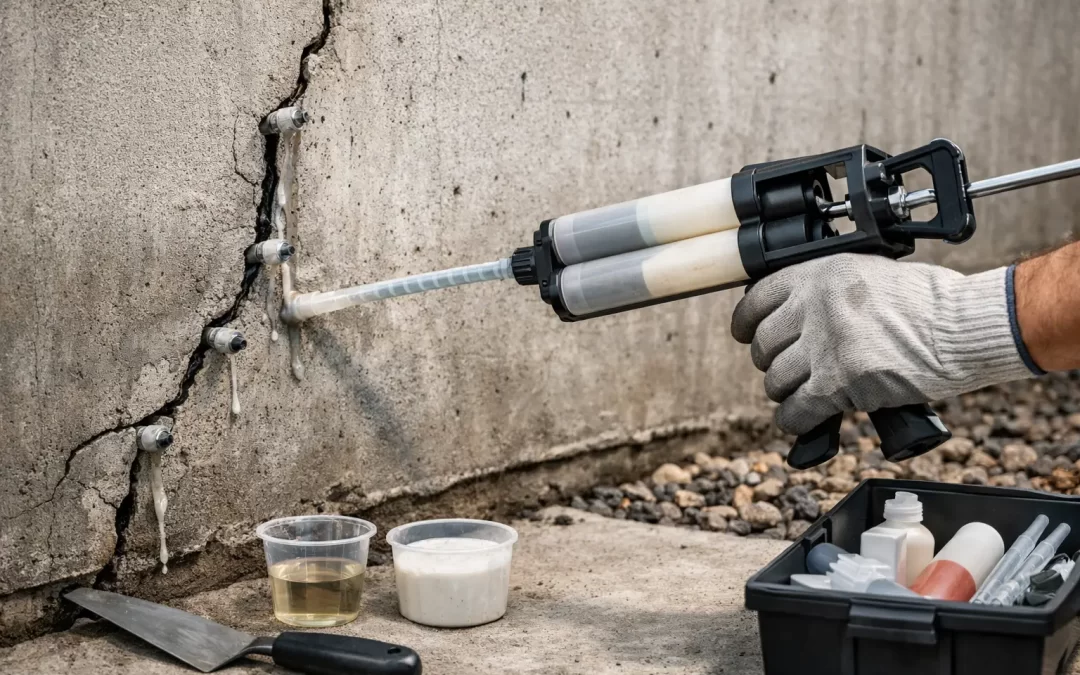
A proper epoxy repair is not just squeezing material into a visible opening. The wall surface is usually cleaned first, and injection ports are installed along the crack. The exposed face of the crack is sealed so pressure can force the epoxy deep into the wall instead of letting it leak back out.
The epoxy is then injected in stages, usually from the bottom upward on vertical cracks, so the material fills the void consistently. Once the epoxy cures, the ports and surface seal can be removed or ground smooth, depending on the finish required.
The success of this process depends on preparation and material selection. If the crack contains moisture, debris, loose material, or active seepage, bond quality can suffer. If the pressure is wrong or the crack branches internally, the repair may not fully penetrate. This is one reason do-it-yourself kits can be hit or miss. The material itself is only part of the repair.
What property owners should watch for before choosing epoxy
If you are considering an epoxy repair, pay attention to what the crack is telling you. A single vertical crack in a poured wall is not the same as stair-step cracking, a horizontal crack, or a wall that is pushing inward. Width matters, but pattern matters more.
Water behavior matters too. A crack that stays dry year-round is different from one that leaks during wet seasons. If there is staining, efflorescence, damp insulation, musty odor, or puddling nearby, the problem may involve exterior water management rather than just the concrete itself.
You should also look for signs of movement beyond the basement. Sloping floors, drywall cracks, window binding, and gaps around trim can point to settlement or shifting support conditions. In those cases, treating the visible wall crack alone is not enough.
Epoxy vs polyurethane for foundation cracks
This is one of the most common questions, and the answer depends on the repair goal.
If the goal is to structurally bond a dormant crack in poured concrete, epoxy is often the better fit. It cures hard and can restore continuity across the cracked section. If the goal is to stop water in a crack that may still move slightly, polyurethane is often preferred because it expands and stays more flexible.
Neither product is automatically better. They solve different problems. The mistake is choosing a material based on popularity instead of crack behavior. A wet, active crack repaired with rigid epoxy can fail. A structurally significant but dry crack repaired only as a flexible water seal may still leave the wall without the level of reinforcement needed.
Why professional assessment saves money
Most expensive foundation repairs start with delay or misdiagnosis. A homeowner sees a crack, waits through one more season, then discovers the wall is leaking, interior finishes are damaged, and exterior drainage is still forcing water against the foundation. By then, the repair plan is larger and more expensive than it needed to be.
A good assessment does not always lead to the biggest repair. Sometimes the fix really is a straightforward injection. Other times, the right answer includes drainage improvements, exterior waterproofing, sump pump work, concrete restoration, or structural correction. The value is in knowing which problem you actually have before spending money on the wrong material.
For commercial buildings and larger concrete structures, this becomes even more important. Cracking can relate to reinforcement corrosion, joint failure, loading, or moisture-related deterioration that extends beyond one visible area. In those cases, epoxy may be one tool within a broader repair scope, not the entire solution.
The bottom line on foundation crack repair epoxy
Foundation crack repair epoxy is a strong repair method when the crack is stable, the concrete is suitable, and the goal is structural bonding. It is not a cure-all for every leaking or shifting foundation. The difference between a lasting repair and a repeat problem usually comes down to one thing: whether the crack was diagnosed correctly before anyone reached for a repair product.
If you are looking at a crack now, do not focus only on filling it. Focus on what caused it, whether it is still moving, and how water is interacting with the wall. That is the kind of decision that protects a foundation for the long term instead of just getting you through the next rain.