
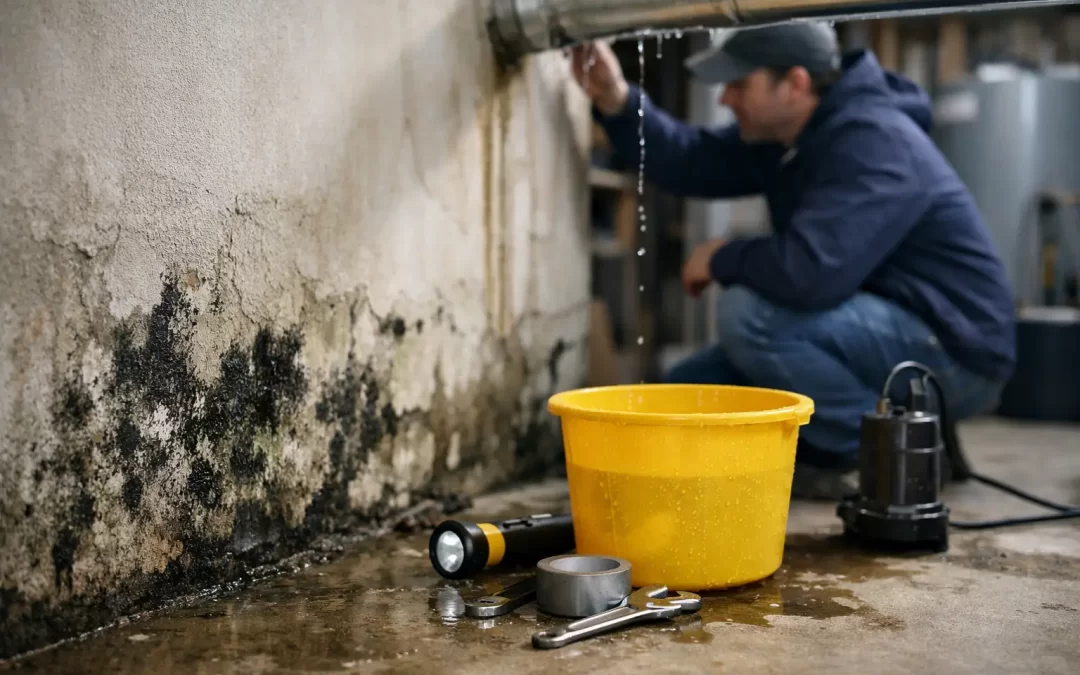
That musty smell in a basement usually shows up before the staining does. By the time you see dark patches on drywall, wood, or stored boxes, basement mould from leaks has often been growing for weeks. The mould is the symptom. The leak is the problem. If you only clean the surface and ignore where the water is getting in, it comes back.
In Winnipeg and across Manitoba, that happens a lot. Clay-heavy soils hold water, freeze-thaw cycles open up weak points, and spring melt puts pressure on foundation walls. A basement can stay dry for years and then suddenly start taking on water after one wet season, one crack opens wider, or one drainage line stops doing its job.
Why basement mould from leaks spreads so quickly
Mould does not need a flood. It needs moisture, organic material, and time. A slow foundation seep, a wall crack that only leaks during heavy rain, or condensation caused by damp masonry can be enough to get it started. Drywall paper, wood framing, carpet backing, and stored cardboard all give it something to feed on.
What makes basements tricky is that leaks are often hidden. Water can enter through a crack behind finished walls, along a wall-floor joint, around a service penetration, or through porous concrete. The visible mould may show up several feet away from the actual entry point. That is why a quick bleach wipe rarely solves anything.
There is also a timing issue. If materials stay damp for more than a day or two, mould growth becomes much more likely. In a finished basement, trapped moisture behind insulation and paneling can linger far longer than most property owners realize.
The leak sources that cause mould in basements
Not every wet basement has the same fix. The right repair depends on where the water starts and how it moves through the structure.
Foundation cracks
Vertical, diagonal, and step cracks can all allow water into the basement. Some are minor shrinkage cracks. Others point to settlement or outside pressure against the wall. If water is entering through a crack, especially during rain or spring thaw, the crack needs to be assessed and properly repaired, not just covered.
Wall-floor joints
A lot of basement leakage shows up where the wall meets the slab. Hydrostatic pressure pushes water to the path of least resistance, and that joint is a common weak spot. If mould is growing along baseboards or lower finished walls, this area should be checked first.
Poor exterior drainage
Clogged or short downspouts, negative grading, and saturated soil near the foundation can keep water pooled where it does the most damage. In many homes, the basement problem starts outside. Water management at the surface is often the first line of defense.
Failing waterproofing or aging materials
Older foundations may have deteriorated damp-proofing, honeycombed concrete, or mortar joints that no longer resist water well. Repeated wetting over time can also degrade finishes and create ideal mould conditions.
Plumbing or interior moisture issues
Not every mould problem is a foundation leak. Condensation on cold surfaces, a hidden plumbing drip, or a poorly ventilated basement can also be involved. But when the staining is concentrated near exterior walls, cracks, or seepage points, water intrusion through the foundation is usually part of the picture.
Why cleaning mould is not the same as fixing the basement
This is where many property owners lose time and money. They remove a section of drywall, spray a cleaner, run a fan, and think the issue is handled. Then the next storm hits, the wall gets damp again, and the smell returns.
A proper response has two parts. First, damaged or contaminated materials may need to be removed and cleaned safely, depending on the extent of growth. Second, and more important, the leak path has to be identified and repaired. If that does not happen, remediation becomes a temporary cosmetic job.
It also matters how long the leak has been active. Repeated moisture can affect sill plates, framing, insulation, flooring, and stored contents. In more advanced cases, it can contribute to rot, corrosion of metal components, and broader indoor air quality concerns.
Signs the problem is more than surface mould
A few spots on a cold pipe are one thing. Basement mould tied to a leak usually comes with a wider set of warning signs.
You may notice peeling paint, efflorescence on concrete, warped trim, damp carpet edges, rust on metal items, or a persistent earthy odor that gets stronger after rain. Some homeowners first spot it when they move a couch, open a storage room, or pull out boxes that have been sitting against a basement wall.
In finished spaces, bubbling drywall tape, staining near the bottom of walls, and soft baseboards are common clues. In unfinished basements, white mineral deposits, darkened wood, and recurring dampness at the wall base often point to active infiltration.
If the mould keeps returning in the same area, that is a strong sign the water source is still active.
What the right fix usually looks like
There is no single repair that fits every basement. A contractor who understands foundations should be looking for the cause, not guessing based on the stain pattern alone.
Start with the source of entry
If the leak is tied to a crack, the repair may involve crack injection or a more structural correction if movement is part of the problem. If water is entering at the wall-floor joint, interior drainage or sump system improvements may be needed. If the exterior grade is directing water toward the home, grading and downspout corrections can make a major difference.
Remove moisture-prone materials when necessary
Once drywall, insulation, carpet, or wood trim has been repeatedly wetted, some of it may need to go. Keeping saturated material in place can trap moisture and allow mould to continue behind finished surfaces. This is especially true if the wall cavity has stayed damp over multiple leak events.
Dry the area properly
Drying is not just opening a window for a few hours. Basements often need controlled air movement and dehumidification to pull moisture out of framing and concrete-adjacent materials. Without that step, the area may still be damp even if the visible surface looks dry.
Build back with the basement environment in mind
After repairs, it is worth thinking about what belongs in a basement and what does not. Some finish materials handle occasional moisture far better than others. Depending on the basement’s history, it may make sense to avoid highly absorbent materials in vulnerable areas.
When mould points to a bigger foundation issue
Sometimes mould is just the first thing you notice. The more serious issue may be movement in the foundation itself. If leaks are happening through widening cracks, if walls are bowing, or if floors are shifting, the water problem and the structural problem may be connected.
In this region, expansive clay soils can move significantly as moisture levels change. That movement can stress foundation walls, open cracks, and increase infiltration. Left alone, the repair gets bigger. What starts as a wet corner and mouldy drywall can turn into major structural and interior restoration work.
That is why early intervention matters. It is usually far less expensive to repair an active leak and correct drainage than to rebuild finished spaces after years of repeated moisture damage.
What homeowners and property managers should do now
If you suspect basement mould from leaks, do not wait for a larger patch or a stronger smell. Check whether the mould is near an exterior wall, crack, window well, or wall-floor joint. Pay attention to whether it worsens after rainfall or spring thaw. Look outside too. Standing water, poor slope, and short downspouts can tell you a lot.
If the affected area is small, you may be able to contain the immediate mess, but do not mistake that for a full repair. The key is getting the water entry diagnosed correctly. For larger affected areas, recurring growth, or any sign of structural cracking, bring in a foundation specialist who deals with moisture intrusion and foundation repair together.
That is the practical difference between patching symptoms and solving the problem. Companies like Foundation Pros of Winnipeg approach these issues by tracing the leak back to its source, assessing whether the foundation itself is part of the failure, and recommending repairs that match the actual condition of the building.
A dry basement is not just about comfort. It protects framing, finishes, air quality, and the long-term value of the property. If your basement smells musty, shows staining, or keeps getting damp in the same spot, treat it as an active warning sign. The sooner the leak is fixed, the easier it is to stop the mould from becoming a much bigger repair.